

Getting Your Box Ready
People often put this off because they think there is a lot of preparation involved. There is not. The short version is to put it all in a box and bring it, and to resist the urge to test anything first.
The Three Things That Actually Help
Bring everything, including the things you are not sure about. It costs nothing to have me look, and the item people nearly leave behind is very often the interesting one.
Keep things in the order you found them. If a shelf held a run of tapes in sequence, bring them in that sequence. Order is information, and once it is scrambled it cannot be put back.
Tell me anything you know. A note saying "these are Mum's, roughly 1978 to 1985" is worth more than an hour of my guessing, and it ends up in how the files are named.
That is genuinely it. You do not need to clean anything, label anything, or sort anything.
Do not play them to check
A tape that has sat for twenty years is at its most fragile the first time it moves, and an old camcorder or a garage-sale VCR is the most likely thing to chew it. If you want to know what is on something, that is part of the job. Let it happen on a maintained machine.
Do not clean anything
Wiping a dusty print can grind the dust into the emulsion, and household cleaners are the fastest way to ruin a slide. Mould on a tape needs proper handling rather than a cloth. Bring it as it is, dirt included.
Do not pull stuck photos out
Photographs stuck to the plastic film of an old magnetic album will tear if you pull them. There are ways to deal with that, and none of them involve force. Bring the album whole and leave it to me.
A Few Things Worth Bringing With It
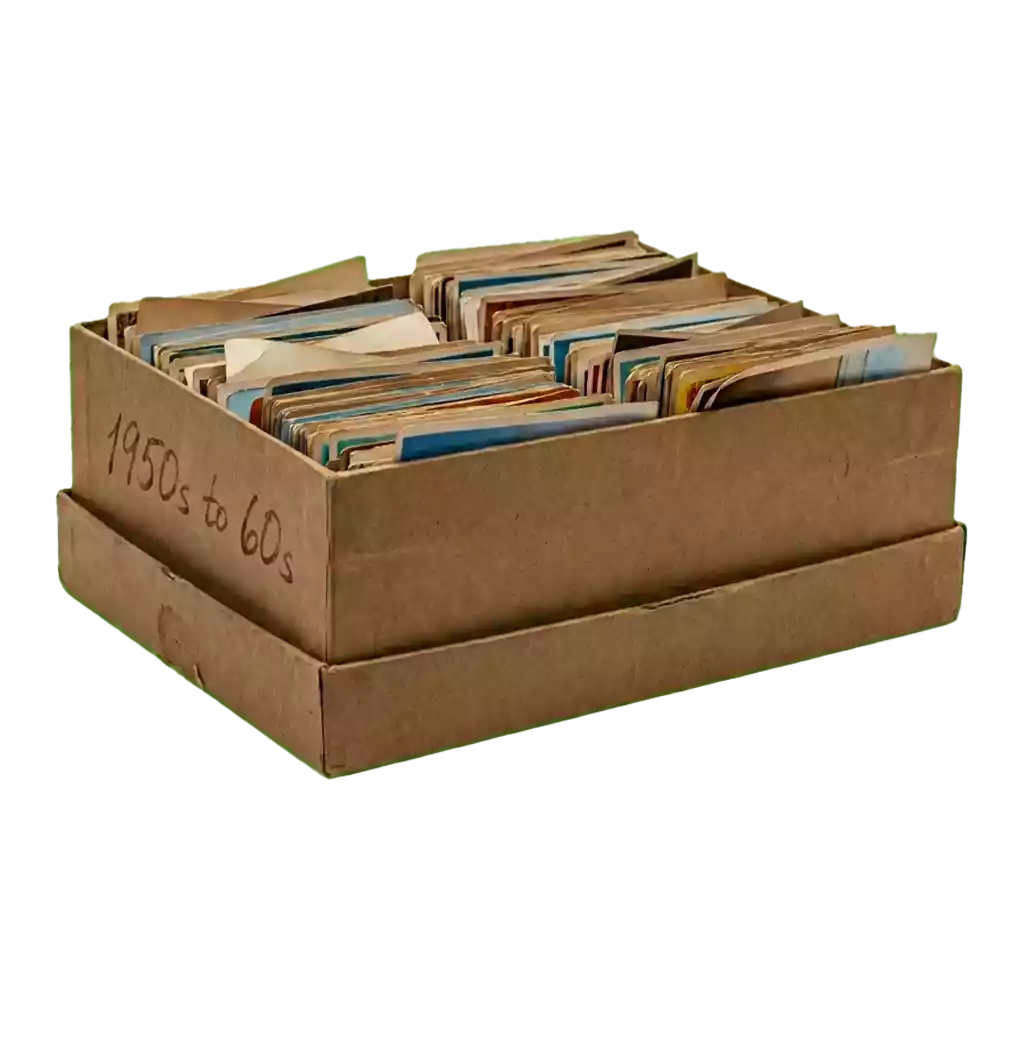
If there is a box or tin the collection lived in, bring that too. The labelling on the outside is often the only clue to what is inside.
If somebody in the family knows who is in the photographs, bring what they told you, even scribbled on the back of an envelope. Names are the part that gets lost first and cannot be recovered later.
If a tape came out of a particular camcorder and you still have it, mention that. It sometimes tells me what format I am dealing with before I have opened anything, though you do not need to bring the machine itself.
What you do not need: the cables, the chargers, the manuals, the adapters, or the player. None of it is used here.
Questions People Ask
Should I sort out which photographs I want scanned first?
Only if you want to. Most people find it much easier to decide once they can see everything as files rather than sitting on the floor with shoeboxes. If you do want to cut the volume down first, that is a real way to save money and I will show you how the pricing changes.
Some of my tapes are mouldy. Should I clean them?
No, please leave them exactly as they are and tell me when you drop them off. Mould gets ground into the tape and spread through the pack by well-meant cleaning, and it also gets into the machine and then into the next client's tape. It is dealt with here, properly, before anything plays.
Do I need to label everything?
No. Bring it unlabelled. Working out what is on unmarked tapes is part of the job and you get a list at the end. What does help is keeping things in the order you found them, because that order often turns out to be chronological.
How should I pack it?
Anything sturdy with a lid. A plastic bin is ideal because it stacks and it does not collapse. Do not overfill a cardboard box to the point where you have to carry it from underneath, and if something is fragile put it on top rather than at the bottom.
Put it in a box and bring the box.
That really is the whole preparation. Book a time and we will go through it together, and I will tell you what is worth doing before you spend anything.